

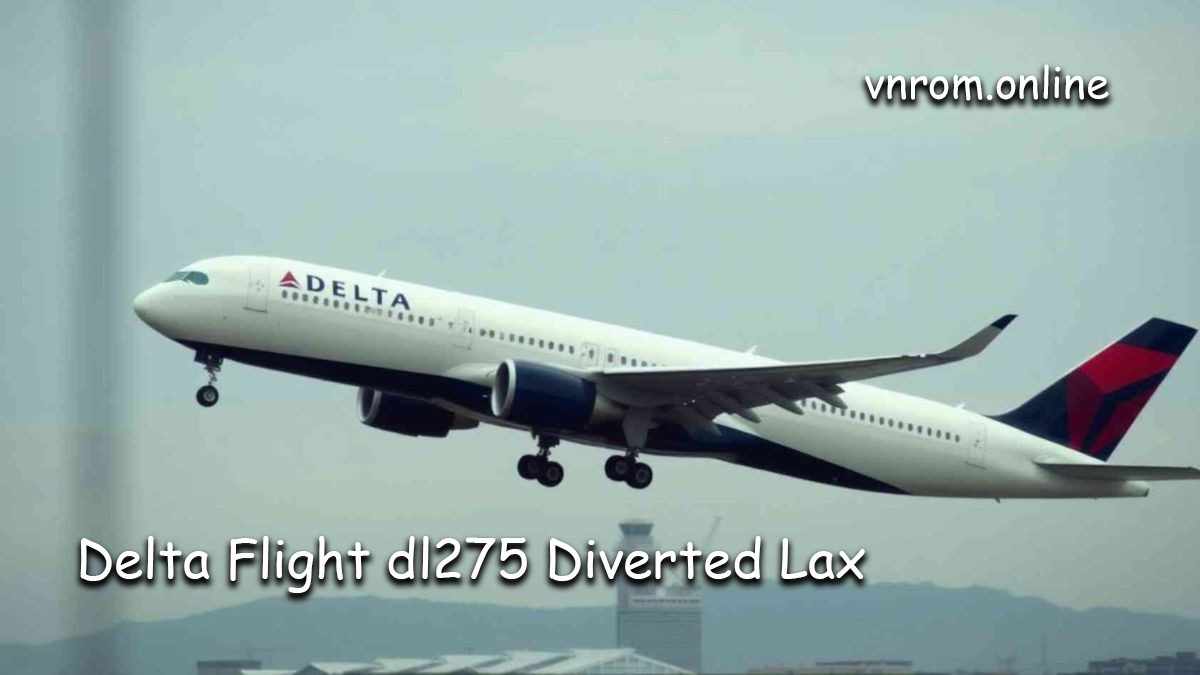
The moment the pilot’s voice crackled over the intercom, everything changed. I remember sitting in my own seat years ago during a similar situation, that sick feeling in the pit of my stomach when you realize this isn’t a normal flight. For the 287 passengers aboard delta flight dl275 diverted lax on May 28, 2025, that moment became a memory none of them would forget .
The Day Everything Changed at 38,000 Feet
Let me paint you a picture. You’re settled into your seat on a Delta Airbus A350, that new plane smell still lingering in the air. You’ve got your noise-canceling headphones on, maybe you’re watching a movie or catching some sleep. The flight from Detroit to Tokyo was supposed to take about 13 hours .
Then things get weird.
The flight attendants start moving through the cabin more frequently. They’re having hushed conversations. If you’re a frequent flyer like me, you know that look. It’s the professional version of “something’s up.”
The aircraft was cruising at 38,000 feet over the Bering Sea, about 620 nautical miles southwest of Anchorage, Alaska, when the engine anti-ice system on the Rolls-Royce Trent XWB engine began showing signs of failure . Outside, temperatures had dropped to minus 67 degrees Fahrenheit. Not exactly the kind of place you want to have mechanical issues.
Here’s the thing about flying over the Pacific that most passengers don’t think about. There aren’t many places to land. You’re hours from anywhere. So when the crew detected that fault, they had a decision to make.
Why LAX Made Perfect Sense
When you hear “delta flight dl275 diverted lax,” you might wonder why Los Angeles? Why not turn back to Detroit or push through to Tokyo?
The answer is surprisingly simple. LAX is a major Delta hub with full maintenance facilities for the Airbus A350 . The aircraft, registration N508DN, was closer to California than anywhere else with the right equipment and trained technicians .
Think of it like your car breaking down on a road trip. You wouldn’t drive past three towns with repair shops just to get to your original destination. You’d stop where help exists.
The crew made the call to divert approximately five and a half hours before touching down at LAX . That’s a long time to sit with uncertainty.
Living Through the Diversion: Passenger Stories
I’ve been reading through passenger accounts, and they’re fascinating. Some people noticed the course change immediately. Mark Rodriguez, traveling with his family, pulled up the flight tracker on his phone and saw they weren’t heading toward Japan anymore . That’s when the worry set in.
Others remained blissfully unaware until the captain’s announcement. And what an announcement it must have been.
Captain Sarah Mitchell, who has 15 years with Delta and eight years on the A350, addressed the passengers with what witnesses described as the perfect tone . She explained the technical issue without causing panic, confirmed they were diverting as a precaution, and gave everyone a timeline.
David Park, a business consultant in seat 12A, had a reaction I completely understand. “My heart sank. Not because I was scared for our safety – the captain’s tone was reassuring – but because I knew this meant my entire Tokyo schedule was shot” .
Been there, my friend. Been there.
Jennifer Walsh in seat 34F had a different perspective. She actually felt relieved. The crew had been acting strangely for nearly an hour, and not knowing was worse than knowing they had a plan .
The Human Element in Crisis
Here’s what strikes me about this whole situation. For 45 minutes before any announcement, the crew knew something was wrong . They were coordinating with Delta’s Operations Control Center in Atlanta, running checklists, preparing for contingencies. And yet they kept serving drinks, checking on passengers, maintaining that calm exterior.
That’s training. That’s professionalism. That’s the difference between a safe diversion and chaos.
Flight attendant Maria Rodriguez, the chief purser, later explained that crews are trained to maintain normal service even during emergencies . But frequent flyers can sense when something’s different.
Sarah Thompson, a business traveler with about 200 Delta flights under her belt, picked up on the cues immediately. “The crew was still professional and friendly, but there was an undercurrent of tension” .
The Technical Side Made Simple
Let me break down what actually happened, because aviation jargon can get confusing fast.
The Airbus A350-900 has these incredibly sophisticated engines made by Rolls-Royce. They’re amazing pieces of engineering. But they have systems that need to work perfectly, especially at high altitudes where ice can form.
The anti-ice system uses air heated to 400-600 degrees Fahrenheit to prevent ice buildup on critical engine components . When that system showed faults over the Bering Sea, the crew had to act. Ice formation on engine parts can lead to catastrophic failure. Not a gamble you take with 287 lives.
Here’s an analogy I like. Imagine you’re driving through a mountain pass in winter. Your defroster stops working. You can still see okay for now, but if fog rolls in or snow starts falling, you’re in trouble. Do you keep driving deeper into the mountains, or do you turn back to the last town with a repair shop?
You turn back. Every single time.
What Happened After Landing
The aircraft touched down at LAX on runway 06R at 1:08 AM local time . By then, it had been in the air for 12 hours and 15 minutes. That’s almost as long as the original flight to Tokyo would have taken.
For context, the Detroit to Tokyo route normally takes about 13 hours and 10 minutes . So passengers essentially flew to California, spent almost the same amount of time in the air as they would have to reach Japan, and ended up on the wrong coast.
The aircraft remained on the ground at LAX for approximately 18.5 hours undergoing inspection and repairs . Passengers were rebooked on other flights, provided with hotel accommodations, and given meal vouchers.
Dr. Robert Kim, a physician traveling in Delta One, noted that from a medical perspective, the situation was handled exactly as it should have been . No injuries, no panic, just professionals doing their jobs.
The Bigger Picture: Why Diversions Happen
Here’s something that might surprise you. Flight diversions aren’t that rare. Delta alone had multiple diversions on the same day as DL275 . A flight from New York to Miami diverted after a loud noise during takeoff. Another from New York to Atlanta diverted due to cockpit smoke detection.
The difference is that most diversions don’t make headlines because they’re handled smoothly. They’re just part of aviation safety culture.
When you step onto an airplane, you’re participating in a system built on redundancy and precaution. Everything has a backup. Every decision prioritizes safety over schedule. That’s why commercial aviation is among the safest ways to travel.
What Travelers Can Learn From This
If there’s one thing I want you to take away from this story, it’s preparation.
Lisa Chen, traveling alone to visit family in Tokyo, described how strangers started talking to each other during the diversion . The woman next to her, silent for six hours, suddenly wanted to discuss what might be happening. There was shared uncertainty that brought people together.
You can prepare for these situations. Here’s how:
Keep your devices charged. The WiFi on that flight became a lifeline for passengers notifying family and rescheduling meetings .
Pack snacks and medications in your carry-on. You never know how long you’ll be sitting on a plane or waiting in an airport.
Know your rights. Airlines typically provide accommodations and rebooking during mechanical diversions.
Stay calm and be kind to the crew. They’re dealing with the same situation you are, plus the responsibility of managing it.
The Aircraft That Made It Possible
The plane involved, registration N508DN, is a 7.31 year old Airbus A350-900 . It was delivered to Delta in March 2018 and configured with 32 business class seats, 48 premium economy seats, and 226 economy seats .
That aircraft did exactly what it was designed to do. Its systems detected a problem early. The crew responded appropriately. It landed safely and was repaired.
After 18.5 hours on the ground at LAX, it returned to service . That’s the happy ending nobody talks about. The plane flew again.
Connecting With the Human Story
I keep coming back to the passengers. Linda Martinez was traveling with her elderly mother in seats 41A and B. She later described how flight attendants checked on her mom multiple times, helped her to the bathroom when she was nervous about walking during turbulence, and brought extra pillows .
That’s the part that doesn’t show up in technical reports. The human kindness.
Michael Brown in seat 7A ended up talking for two hours with a retired teacher heading to Tokyo to visit her daughter . A diversion became an unexpected connection.
These moments matter. They remind us that even when things go wrong, people show up for each other.
Final Thoughts: Safety First, Always
The delta flight dl275 diverted lax incident isn’t a story of failure. It’s a story of systems working. The engine anti-ice system detected a fault. The crew recognized the risk. They diverted to an appropriate airport. Passengers were accommodated. The aircraft was repaired.
Nobody got hurt. That’s the only metric that truly matters.
I’ve flown hundreds of thousands of miles in my life. I’ve had my share of delays, cancellations, and one memorable diversion due to weather. Every time, I remind myself of something a pilot once told me: “The safest place for an airplane with a problem is on the ground.”
So the next time you hear about a diverted flight, don’t assume the worst. Recognize it for what it usually is. A precaution. A professional decision. A commitment to getting everyone home safely, even if it takes a little longer than planned.


