

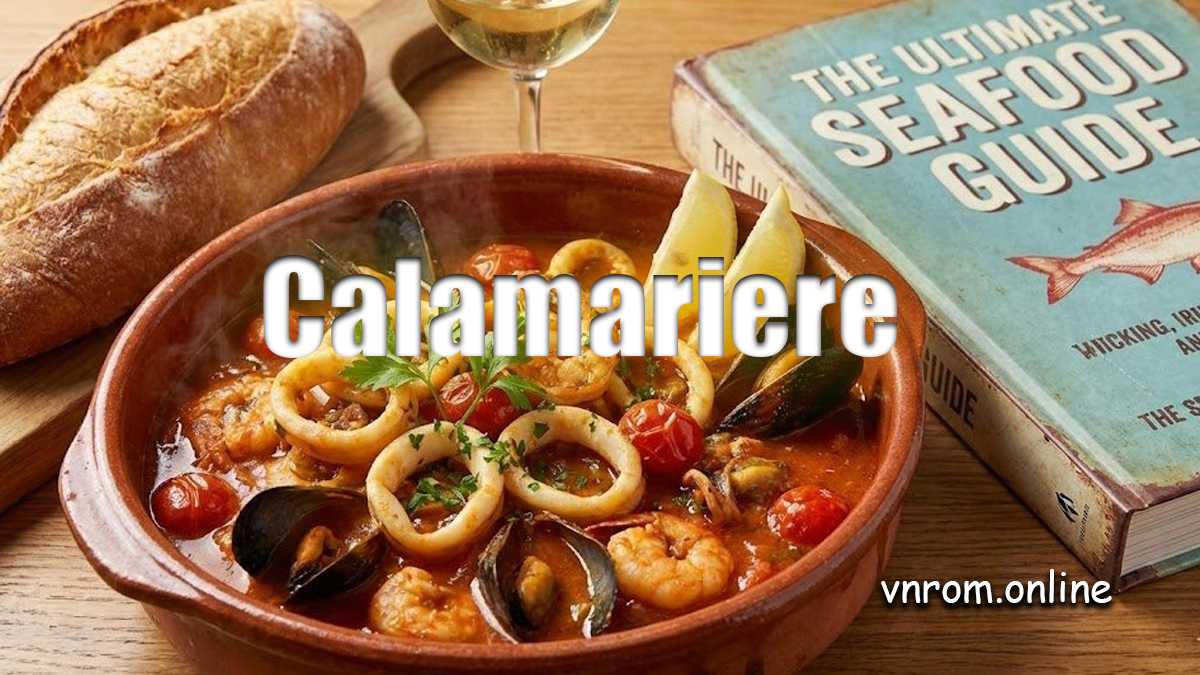
Let me tell you about the first time I truly understood what a calamariere really was. I was standing in a tiny kitchen in Sorrento, Italy, watching a woman who had been cooking Italian seafood for over fifty years. She held a squid in her hand like it was a delicate piece of silk. She didn’t rush. She didn’t overcomplicate things. She simply knew, with a quiet confidence, exactly what that squid needed. That, right there, was my introduction to the calamariere way of thinking. It’s not a gadget you buy or a single recipe you follow. It is a philosophy, a quiet art form rooted deeply in Mediterranean cuisine, and once you understand it, your kitchen will never be the same.
For years, I had been intimidated by calamari. I’d order it at restaurants—golden, tender rings of calamari fritti—and wonder why my attempts at home always turned into rubbery, sad little circles of disappointment. I blamed the squid. I blamed my pan. I even blamed the olive oil once, which, looking back, was a little dramatic. But the truth was simpler and far more humbling. I just didn’t know how to think like a calamariere.
If you are reading this, you are probably in the same boat I was. You want to create that perfect plate of fried calamari, or maybe you are dreaming of a silky stuffed squid simmered in a fragrant tomato sauce. You want to impress your family or simply treat yourself to something extraordinary. The good news is that the secrets I am about to share are not complicated. They are, in fact, beautifully simple. They just require a shift in perspective. So, pull up a chair, pour yourself a glass of something nice, and let me walk you through the 21 easy calamariere secrets that actually work.
Secret 1: Embrace the Philosophy, Not Just the Recipe
Being a calamariere is about respect. It sounds a little woo-woo, I know, but stick with me. When you approach squid preparation with the mindset of a craftsman rather than a cook following a set of instructions, everything changes. It is the difference between painting by numbers and creating art. The woman in Sorrento wasn’t measuring ingredients. She was feeling them. She was listening to the sizzle of the olive oil. She was watching the curl of the squid as it hit the heat. When you start cooking with that kind of attention, you stop being afraid of failure. You become curious instead of anxious.
Secret 2: Start with the Freshest Squid You Can Find
I cannot stress this enough. Your calamariere journey begins at the fish market, not in your kitchen. Fresh squid should smell like the sea, not like fish. It should be firm to the touch, with clear, bright eyes. If you are buying frozen, look for squid that has been frozen at sea. This is often even better than “fresh” squid that has been sitting on ice for days. The texture and flavor of high-quality seafood are non-negotiable here. You wouldn’t build a house on a shaky foundation, and you shouldn’t build a dish on subpar squid.
Secret 3: Master the Art of Cleaning
Confession time. I used to dread cleaning squid. I would buy it pre-cleaned, paying a premium for the convenience, and still end up with bits of beak or quill in my final dish. It was a mess. Learning to do it yourself is one of the most empowering squid preparation skills you can develop. Gently pull the head and tentacles away from the body. The innards will come with them. Remove the hard beak from the center of the tentacles and discard it. Then, pull out the clear plastic-like quill from inside the body. Rinse everything under cold water, and you are done. It takes less than two minutes once you get the hang of it. It connects you to your food in a way that buying a plastic tray of cleaned rings never can.
Secret 4: Understand the Enemy: Toughness
The reason most people fear cooking squid is the rubber band effect. It is a culinary boogeyman. But here is the science behind it, and once you understand it, you win. Squid muscle is made of collagen. When you cook it, that collagen either tightens up into rubber or breaks down into tender, melt-in-your-mouth goodness. There is no middle ground. You have to cook it either very fast (for a minute or two) or very slow (for forty-five minutes or more). Anything in between is a one-way ticket to Chew Town. A true calamariere knows this timing is everything.
Secret 5: The Two Paths to Tender Squid
So, you have two paths. The first is the high-heat, quick-cook path. Think grilled squid or calamari fritti. The second is the low-and-slow path. Think braised stuffed squid or squid stew. Before you even turn on the stove, you must decide which path you are taking. Your entire approach—from how you cut the squid to what you serve it with—will hinge on this single decision. It is like choosing between a sprint and a marathon. You train differently for each.
Secret 6: Tenderizing Squid the Right Way
If you are taking the fast-cook path, you might be tempted to use mechanical tenderizing squid methods. I have seen people score the inside of the tubes with a sharp knife in a crosshatch pattern. This is a classic calamariere trick. It not only helps break up some of the tough muscle fibers but also creates more surface area for browning and allows the squid to curl into those beautiful little pinwheels we all love. It is a small step that makes a world of difference.
Secret 7: The Pasta Connection
One of the most common points of confusion in Italian cooking is the difference between a calamariere and calamarata pasta. They sound so similar, don’t they? Calamarata is a specific type of pasta, shaped like thick rings that resemble, you guessed it, calamari. It is often served with a rich seafood sauce. A calamariere, on the other hand, is the person or the concept behind the perfect preparation of the squid itself. They are siblings, not twins. If you want to truly embrace the lifestyle, serve your perfectly cooked squid over a bed of calamarata pasta. It is a match made in Mediterranean cuisine heaven.
Secret 8: The Oil Is Your Canvas
In Mediterranean cuisine, olive oil is not just a fat for frying. It is a flavor carrier, a textural component, and a symbol of generosity. For my calamariere practices, I always use a high-quality extra virgin olive oil. When I am making calamari fritti, I use a neutral oil with a high smoke point for the actual frying, but I finish the dish with a drizzle of that peppery, green extra virgin stuff. It is the final brushstroke on a painting. It adds a layer of complexity that makes people stop mid-bite and ask, “What did you do to this?”
Secret 9: The Art of Calamari Fritti
Let’s talk about the crown jewel: calamari fritti. I ruined more batches of this than I care to admit. I would either overcrowd the pan, causing the temperature to drop and the squid to steam instead of fry, or I would use the wrong coating. The secret is threefold. First, dry your squid thoroughly. Moisture is the enemy of crispiness. Second, use a light coating of semolina flour or a mix of flour and cornstarch. You are looking for a whisper of a coating, not a heavy breading. Third, fry in small batches at 375°F (190°C) for no more than 60 to 90 seconds. The moment it turns golden, it is done. Get it out of the oil. Do not hesitate. Hesitation leads to rubber.
Secret 10: The Garlic and Lemon Rule
There is a reason you almost always see garlic and lemon paired with calamari. It is not just tradition; it is chemistry. The brightness of the lemon cuts through the richness of the fried exterior, while the garlic adds a savory depth that complements the delicate flavor of the squid. When I serve calamari fritti, I toss the hot squid with a clove of minced raw garlic, a generous sprinkle of sea salt, and a squeeze of fresh lemon juice. The residual heat from the squid gently cooks the garlic, infusing every bite. It is simple, yet it tastes like pure magic.
Secret 11: Exploring Squid Recipes
There is a whole universe of squid recipes beyond fried rings. One of my favorites is a simple grilled squid. You marinate the whole cleaned tubes and tentacles in olive oil, lemon zest, oregano, and a pinch of chili flakes for about twenty minutes. Then, you throw them on a screaming hot grill for two minutes per side. The result is smoky, charred, and incredibly tender. Serve it with a simple arugula salad, and you have a meal that tastes like a seaside vacation.
Secret 12: The Stuffed Squid Tradition
Then there is stuffed squid. This is where the low-and-slow path really shines. I stuff the squid tubes with a mixture of breadcrumbs, garlic, parsley, pine nuts, and sometimes a little anchovy for depth. I secure the opening with a toothpick and gently simmer them in a simple tomato sauce for about forty-five minutes. As they cook, the sauce absorbs the flavor of the sea, and the squid becomes so tender it practically falls apart. It is comfort food at its finest. It is the kind of dish you make on a Sunday afternoon when you want the whole house to smell like a Neapolitan cuisine dream.
Secret 13: Cooking Cephalopods with Confidence
Once you master squid, you will find that your confidence with all cooking cephalopods—octopus, cuttlefish—grows exponentially. They share similar structural challenges. A calamariere is not a one-trick pony. The skills you develop—timing, temperature control, and respect for the ingredient—translate directly. I remember the first time I successfully cooked octopus using the same low-and-slow method I had perfected with squid. I felt like I had unlocked a secret level in a video game.
Secret 14: The Mediterranean Diet Connection
What I love about this style of cooking is how naturally it aligns with the Mediterranean diet. It is not about restriction. It is about celebrating whole, fresh ingredients. Olive oil, fresh seafood, herbs, garlic, and lemon. These are not just ingredients; they are the pillars of a way of eating that is as healthy as it is delicious. When I cook as a calamariere, I feel good about what I am putting into my body. I am nourishing myself and my family with food that has been enjoyed for generations along the Italian coast.
Secret 15: Your Kitchen Tool Arsenal
You do not need a lot of fancy gear to cook like a calamariere, but there are a few kitchen tool essentials that make the process easier. A good, heavy-bottomed pan for frying or searing is crucial. A sharp knife for cleaning and scoring is non-negotiable. I also highly recommend investing in a simple food thermometer. Guessing the temperature of your frying oil is like guessing if a cake is done by looking at it. The thermometer takes the guesswork out and guarantees consistent results.
Secret 16: A Personal Anecdote of Failure
Let me be real with you. A few years ago, I tried to impress a date by cooking a full Italian seafood feast. I was going to make grilled squid, pasta, the whole nine yards. I was so focused on trying to be impressive that I forgot the most basic calamariere principle. I cooked the squid at a medium heat for about ten minutes. It was a disaster. It was so tough we could barely chew it. We ended up ordering pizza, and I spent the evening feeling like a fraud. It was humbling. But that failure taught me more than any success ever could. It forced me to go back to the basics, to ask why it went wrong, and to truly learn the science behind squid preparation. Now, I am grateful for that failure. It made me a better cook.
Secret 17: The Neapolitan Influence
Much of what we consider classic Italian seafood dishes have their roots in Neapolitan cuisine. Naples, with its deep connection to the sea, is where the calamariere spirit truly thrives. The dishes are often simple, using just a handful of ingredients, but they are executed with a level of precision and love that transforms them. When I cook these dishes, I like to think about the fishermen in the Gulf of Naples pulling in their nets. It connects me to a history that is so much bigger than my own kitchen.
Secret 18: Serving with Style
Presentation matters. It is part of the calamariere experience. When I serve calamari fritti, I do not just dump it on a plate. I arrange it on a warm platter, often one I bought from a ceramic shop in Italy. I scatter fresh parsley over the top, add a few wedges of lemon, and maybe even a little sprinkle of chili flakes for color. It takes an extra thirty seconds, but it signals to everyone at the table that this meal is something special. We eat with our eyes first, after all.
Secret 19: Avoiding Keyword Stuffing
In the world of cooking blogs and recipe sites, I see a lot of people getting caught up in trying to cram every possible term into their content. But a true calamariere knows that authenticity trumps all. It is the same in cooking. You do not need to use every spice in your cabinet. You use the ones that belong. You do not need to overcomplicate the recipe. You let the squid recipes speak for themselves. Trust the process, trust the ingredients, and the results will follow.
Secret 20: The Joy of Sharing
The best part of learning to cook like a calamariere is sharing it. I have a friend who swore she hated calamari. She had only ever had the rubbery, overcooked kind. I made her my version of calamari fritti one evening, and her eyes went wide with surprise. “This is what it is supposed to taste like?” she asked. In that moment, I realized that being a calamariere is not just about cooking. It is about changing perceptions. It is about showing people the beauty and joy that comes from Mediterranean cuisine. It is a gift you give to the people you love.
Secret 21: Practice, Practice, Practice
My final secret is not really a secret at all. It is practice. The first time I tried to clean a squid, it took me fifteen minutes and I ended up with more on my apron than in the bowl. The first time I fried squid, I burned it. The first time I stuffed squid, the filling fell out into the sauce. But I kept going. Each time, I got a little better. I became a little more intuitive. I started to feel the rhythm of the kitchen. Becoming a calamariere is a journey, not a destination. It is about showing up, making mistakes, learning from them, and falling more in love with the process each time.
So, there you have it. Twenty-one secrets that took me years to learn, all wrapped up in one article. I hope they save you some of the frustration I went through and help you find your own confidence in the kitchen. Whether you are making a simple plate of grilled squid for a weeknight dinner or an elaborate feast of stuffed squid for a special occasion, remember the heart of the calamariere philosophy. It is about respect, patience, and a whole lot of garlic and lemon. Now, go forth and cook. Your kitchen is waiting.


